D'Annunzio: The Warrior Poet

Updated: Sep 2
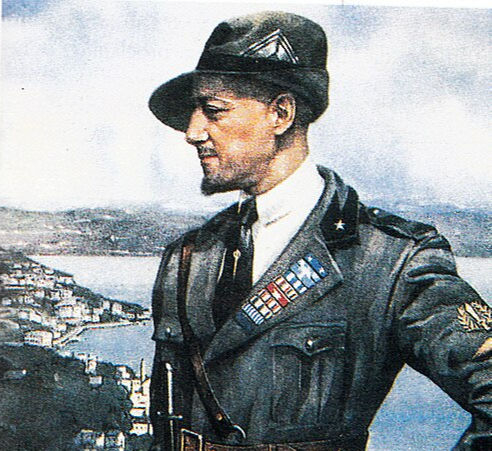
One of the truly great books I had the pleasure of reading as background for Quasi Virile was The Pike: Poet, Seducer and Preacher of War, by British biographer Lucy Hughes-Hallett. While I don't think Nada and Il Vate (The Bard in Italian) were personally acquainted, D'Annunzian sensibilities contextualize just about every business and political choice our heroine made in both the Belle Epoque and the Interwar period.
Let me fill you in on who D'Annunzio was and what he did so you can get an idea of how truly wild this period in Italy's history was.
Gabriele D'Annunzio was born in 1863, in Pescara - the biggest city in the Adriatic region of Abruzzo, just south of Le Marche. He rose to fame with his both his poetry and his penchant for self-promotion. He was a master at manipulating scandal and gossip to his advantage, from a very young age. When he was sixteen, he started a rumor regarding his own demise in a horseback-riding incident, and it served to bolster whatever notoriety he managed to gain at such a young age.
But D'Annunzio was more than a poet. Much more than just a writer. In a time before Hollywood was launching people into super stardom, it was literary stars and opera singers that filled that space in popular culture. And D'Annunzio's philosophy on life, and his undeniable talent, made him easy to talk about.
Imagine a man whose only goal in life is to live his art, to have his art become life and his life become his art. Shameless is not exactly the right word for it, but D'Annunzio seemed to care very little about the consequences of his actions. He was a tireless seeker of beauty and decadence, the architect of the Italian concept of the superuomo - the man's man, the conqueror, the fearless explorer - and a consummate gambler who lost everything to his creditors many times over between his rise in 1889 and his death, right before the Second World War, in 1938.
None of that stopped his philosophy from permeating every aspect of Italian daily life, especially for the young men coming up a generation behind him, who then also adopted Decadence as the battle cry for their art.
When his poetry was no longer enough to pay the bills and the Italian Decadent movement was phased out by the Futurists - more on them later - he reinvented himself as a playwright, orator and politician. And this is where his world intersects with Nada's.
Like her father, Nada was a strong believer in the ideal of a fully unified Italy. While the sacrifices that Ugo made with Garibaldi brought most of Italy under the control of the secular Italian government, there were a few key territories - namely, Trieste, Trento and Fiume - that stayed under the auspices of the Austrian Empire. People, like Nada and D'Annunzio, who believe Italy should continue the fight to unify the continent with these unredeemed lands became known as Irredentists. They pressed the Italian government to go to war against Austro-Hungary in the hopes that these territories could be reclaimed.
The murder of Arch Duke Franz Ferdinand gave them just such an opportunity. And no one pressed harder than D'Annunzio, spinning the uneducated masses into a frenzied mob literally begging for a war. And when Italy joined the fray, so did D'Annunzio, whose crowning military achievement was the Flight Over Vienna in which he and Air Force Captain Natale Palli of the 87th squadron "La Serenissima,", flew to Vienna from Venice and dropped leaflets of poetry over the heads of confused Austro-Hungarians.
But World War didn't deliver like the irredentists had hoped. Italy Annexed Trieste and Trento from Austria, but not Fiume (modern day Rijeka, Croatia). It became a key reason for Italy's rupture with the allies, and rendered their successful intervention in the Great War a "mutilated victory."

And that's when the fifty-six year old D'Annunzio - who was still volunteering as an aviator with the Third Army in Venice - declared himself Duce.
Of Fiume, that is.
He drew from his inner Garibaldi, recruited a small group of volunteers, and made his way down to Rijeka to claim the town for Italy, with an ever-growing tail of soldiers joining his cause as he marched the 70 km there from Friuli-Venezia-Giulia.
And that's when the thirty-six year old Mussolini - who up until then had been a socialist journalist who dabbled in politics - started taking notes.
Before you start to wonder: that is D'Annunzio giving the straight arm salute you have come to recognize as the "sig heil," years before Hitler became a thing. That's because Hitler stole it from Mussolini, who - in a case of life imitating art - stole it from D'Annunzio.


Comments